• The big rip-off: how cheap clothes made us poorer

    This summer, I treated myself to a rare gift — a somewhat expensive pair of trousers. (Olive green Stan Ray Fat Pants, if you must know.) Within a week, a pocket snagged on the sharp edge of a park bench and ripped. I was devastated, cursing the universe for conspiring against me, chiding myself for spending a hundred Great British Pounds on a pair of trousers.

    Until my adult-er half told me to calm down and take them to the tailor around the corner. It made me laugh. What was this, 1925? Shall I stop by the cobbler, I asked. Drop in at the apothecary, too?

    As it turned out, the drycleaners down the street had an in-house tailor. A kindly Bangladeshi man who took one look at my ripped pocket and nodded in that special South Asian way, dismissive yet reassuring. I went back the next day and the rip was gone. Not covered up, not stitched over — disappeared. All for under ten pounds.

    At first, I was aghast that this simple solution hadn’t even occurred to me. Then, I was astounded by the world we live in that made this ignorance possible. You don’t forget about the existence of certain repairers, after all — dentists, auto mechanics, plumbers. How is it, then, that a tailor — not to mention the cobbler — sounds like a dated joke?

    It made me return to a book I had bought a couple of years ago but had never got around to reading.

    The history of clothing is, of course, the history of our species — the only one mad enough to bedeck ourselves in fake fur. To create a focused, engaging story out of this vast, erm, canvas, the book is split into 5 sections — Linen, Cotton, Silk, Synthetics and Wool. Each one unpacks the history of the respective fabric — how it came to be, how it’s made these days and, most importantly, who makes it.

    The book shows how cloth-making was, for thousands of years, both a primary vocation and a means of self expression for people across cultures. And it makes you think of the consequences of having lost both of those things in the span of a few decades.

    Early on, the book casually drops a fact that made me pause for a long moment: for the first time in all of human history, buying clothes is cheaper than making them yourself.

    And then, it goes on:

    The contemporary clothing trade may be valuable, but the clothes produced are not. Between 2000 and 2014, clothing production around the world doubled. This was possible because clothing had become entirely disposable.

    Fast fashion overtook our world so swiftly, so completely, that it’s not only cheaper to buy clothes than make them — that has been true for decades. It’s now cheaper to buy new clothes than repair them. With the likes of Shein, the cost of replacing something as trivial as a button or a zipper can be more than the cost of the garment itself.

    This is absurd. Surely, we can all see that?

    But the toll this transformation has taken on the environment, on our societies and traditions — on human lives — is often devastating. This is where Thanhauser’s book shines, turning the spotlight onto the people who have historically made our clothes and the ones who do it now, and how their lives have been transformed — rarely for the better.

    In one memorable chapter, Thanhauser travels to the Yangtze Delta, the region in China famed for its millenia-old silk industry. It was here that the legendary Silk Road began and ended. It was where the tradition of silk weaving first flourished, turning ‘the shit of the silkworms’ — as one tour guide explains to Thanhauser — into garments that were one the most valuable objects in the world, the only gifts fit for emperors who had it all. Such glorious objects are now confined to museums, glowing behind glass panes like alien artefacts. And the land that made them is now a megapolis, its mulberry fields replaced by a concrete forest. When Thanhauser asks one of the last remaining silk farmers in the region about it, he says, simply: ‘My heart is dying.’

    It is indeed heartbreaking to realise what we have lost. Not only objects of immese beauty, but the art of creating them. For all of our history, making clothes was one of the most accessible forms of art, a means of self expression available to most, admired by all. Today, while a few successful designers are celebrated for their vision, the act of creation itself has been devalued into nothing. The people who may once have crafted wonders now sit crammed into ghastly sweatshops. This loss of everyday creativity, I think, has made us all poorer, leaving a spiritual hole in our psyches.

    I don’t imagine most of us will ever learn how to make our own clothes. In fact, it’s possible that later generations wouldn’t even think of clothes as something that can be made by hand. But, for now, there are still people keeping the art alive. Perhaps it’s worthwhile to find them, to support them, to get our clothes made and repaired by them. And to buy clothes worth repairing in the first place.


    FEATURED BOOK

    Worn: A People’s History of Clothing
    by Sofi Thanhauser


    Get the next one in your inbox

  • Islands of strangers: what a Prime Minister can learn from a podiatrist

    The liberal, left-of-centre Prime Minister of the United Kingdom is worried that his country is becoming ‘an island of strangers’. I think he’s right to be concerned, although probably not for the same reasons. While he seemed to be referring to a tendency amongst immigrants to form sub-cultures and communities (called ‘ghettos’, when the immigrants are poorer and darker-skinned), I think the problem lies elsewhere. It lies in the Prime Minister’s pocket. Just like it does in every one of ours.

    Yep, it’s the socials.

    We’ve had years of research showing how social media algorithms create bubbles of isolation — islands of strangers — to exploit every twitch of our unblinking eyes. They have monopolised our attention, hijacked our economies, captured our regulators. They have convinced us that we’re most connected with the world when we’re alone in the dark, staring at a little screen. It is no longer enough to call it a crisis. It’s a catastrophe. They aren’t unravelling the fabric of society; they have torn it to shreds and set fire to it, replaced it with a plastic shroud of misinformation. If there is no sense of community today, it is not because the darker people talk in funny accents and don’t hang out at Great British flag-draped pubs. It’s because all we know about them comes from fake reels and staged TikToks designed to keep us from talking to them — or anyone else, for that matter. Because every second we spend talking to an actual human being is a second that can’t be monetised by the social platforms.

    The good news? It’s not impossible to fight this. All it takes is looking up.

    Cover image for Marzahn, Mon Amour

    Set in Marzahn, Berlin’s largest communist-era housing estate, it’s a collection of beautiful, intimate portraits of a community that often feels forgotten, stranded on its own island in time.

    Narrated in the first-person by the author, it begins:

    I was forty years old when I reached the middle of the big lake. My life had grown stale: my offspring had flown the nest, my other half was ill and my writing, which had kept me busy until then, was more than a little iffy. I was carrying something bitter within. me, completing the invisibility that befalls women over forty. I didn\’t want to be seen, but nor did I want to see. I\’d had it with people, the looks on their faces and their well-meant advice. I sank to the bottom.

    The rest of the book is a journey back from this bottom.

    Giving up on her writing career, the author trains as a chiropodist and begins working in a Marzahn clinic. Her clients and colleagues are longtime residents who have lived through a world war, the fall of communism, the techno-blasted nihilism of the nineties. From the foot of her pink chair she gets an intimate look at them, hearing their stories and learning about their lives, from the deepest sorrows to the silliest sparks of joy. Like the lives of these others, the intricate vignettes come together to form a collective portrait of a community left for dead but sparkling with life. Through the simple acts of seeing, hearing, touching other people, the narrator-author slowly rebuilds her connection to society, to humanity. And she does it with a love that flows through the pages and seeps right into your soul.

    To anyone who feels isolated, disconnected, embittered by the thought of living on an island of strangers: you might find hope in this book. It shows that all it often takes is not to be a stranger yourself.


    Cover image for Marzahn, Mon Amour

    FEATURED BOOK

    Marzahn, Mon Amour
    by Katja Oskamp, translated by Jo Heinrich


    Get the next one in your inbox

  • Agents of disimagination: chatbots, dark bargains and a forgotten Russian

    Picture this: Two travellers are trekking up the foothills of the Andes, armed with nothing but their phones. Like modern-day Indiana Joneses, they are in search of an ancient wonder, once revered by a lost civilisation for its healing effect on the soul — the Sacred Canyon of Humantay.

    Just a teeny, trivial problem: the place doesn’t exist. It’s made up by the chatbots on their phones.

    It would be funny, if it wasn’t so alarming.

    The greatest trick the techlords have pulled on us has nothing to do with tech. It’s a trick of marketing, as it often is. It’s the branding of chatbots — or Large Language Models; la-di-da — as Artifical Intelligence.

    This misdirection is entirely deliberate, ‘learning’ (as they like to refer to stealing) from generations of science-fiction writers, exploiting the imaginative groundwork of artists that gives the term ‘A.I.’ its cultural cache. It has allowed them to reframe a conceptually basic word-prediction software as something of an enlightened being, as close to an omniscient deity as it gets in our post-religious age. The ploy has worked so well that people now seem to accept these chatbots’ abilities to know more than any old human, trusting their words as a form of higher truth.

    In actual, boring truth, these things can barely be trusted to add two and two.

    That’s because they don’t know what two even means. They can’t know. All they can do is predict the words, one fragment at a time (by ‘decomposing’ text to turn words into ‘tokens’) in an order that’s most likely to sound true. They can guess that the ‘breathtaking beauty of the Tuscan landscape’ is something humans might like to hear. They could be referring to the Windows XP wallpaper, for all they know, or care.

    The upshot? Trusting these things to do anything for us is a two-for-one devil’s bargain. First, we can’t know which fragment of which word they mash up is utter nonsense (neither can they). So, unless we want to double-check every single one of them, the easier option is to give up and just have faith. Second, we start losing the ability to think critically, to question their truths, to add two and two ourselves. So, we surrender those, too. And then we find ourselves lost in the hills, looking for the Sacred Canyon of Humantay.

    [] cultural apparatuses designed to undermine people’s ability to think critically, imagine the unimaginable, and engage in thoughtful and critical dialgogue.

    While Giroux’s idea of ‘the disimagination machine’ is far broader in scope, from school systems to mass media, it seems to apply perfectly to the idea of AI. Borrowing from Giroux and tech’s own terminology, I propose we think of chatbots as agents of disimagination.

    On the one hand, these bots are imagined by their salesmen (they seem to be mostly men) as superior substitutes for humans. On the other hand, they serve to suppress the imaginations of their users, encouraging the surrendering of our critical faculties. thus turning the first proposition into a self-fulfilling prophecy. The more we use them, their salesmen promise us, the smarter the bots get. What if it’s the other way round? What if, with every thought we abandon halfway, every mental effort we seek to outsource, it’s we who get dumber?

    For more imaginative metaphors for this very current fear, I turned, as I often do, to an old Russian.

    The surrealism calls to mind Bulgakov, the author’s more famous compatriot, but new layers keep unraveling as you turn the pages. There is a precision to the fantastical leaps, grounding the madness in the spectacularly mundane. There is a postmodern self-referencing that blurs the lines of fiction (which occurs alongside the actual Eiffel Tower uprooting its iron legs and going on a rampage through Paris). And through it all runs a current of existential irony (a man begins each day by practicing the art of resignation — by leaning against a wall for a couple of minutes).

    It’s the first story, however, that I still think about, a year after first reading it. ‘Quadraturin’ is one of those perfect examples of absurdism that acts like a handgrenade tossed into your head. It starts off as a simple, if abstract, premise, then explodes into a kind of metaphorical awakening, changing the way you look at your own world.

    Here’s the premise: Sutulin lives in an eighty-six-square-foot ‘quadrature’ — the maximum state-mandated space for a single person (true story in 1920s Russia, according to the endnotes). One day, a salesman knocks on the door, offering an experimental solution: ‘an agent for biggerizing rooms’. It’s a paste that, when rubbed evenly across the floor, expands the room. It works. Sutulin can’t believe his luck. But there’s a problem, he soon discovers. In his excitement, or carelessness, he hasn’t applied the paste evenly, so the ‘quadrature’ starts to grow into a misshapen blob. And it doesn’t stop. It grows so big that light from his one lamp can no longer reach the end of it.

    This is how it ends (it’s not a spoiler; this is not a murder mystery):

    In their sleep and in their fear, the occupants of the quadratures adjacent to citizen Sutulin’s eighty-six square feet couldn’t make head or tail of the timbre and intonation of the cry that woke them in the middle of the night and compelled them to rush to the threshold of the Sutulin cell: for a man who is lost and dying in the wilderness to cry out is both futile and belated: but if even so — against all sense — he does cry out, then, most likely, thus.

    It’s a truly remarkable piece of writing, as current as an episode of Severance. It speaks to the creeping desperation of powerless individuals in an arbitrary, inescapable system. It evokes the sense of alienation we feel in a world growing darker, more warped by the day. And it makes you question the basic truth of our age: you, privately, all by yourself, can transform your life — if only you surrender to the techno-capitalists, see no evil in their transparent exploitation of people and the planet, express nothing but gurgling excitement for whatever self-serving ‘solutions’ they shove down your throat. The genius of Krzhizhanovsky lies not in revealing such promises as false, but making us ask ourselves: what if they were true?

    It’s a question we should probably ask ourselves each time we prompt a bot, hoping for some miracle.


    Get the next one in your inbox

  • Resistance is juvenile: Trolling the fash like East Berlin lads

    If you asked people on the street to picture a typical liberal, what do you think they’d see?

    My guess would be some vague stereotype, like a bespectacled, tweedy intellectual, or a gender-defying protestor with a keffiyeh obscuring their ‘meat is murder’ t-shirt. Whatever image comes to mind, I’d wager that it isn’t an average group of teenagers hanging around outside a McDonald’s. An yet, on nearly every social issue, from sex and abortion to immigration and equality, young people almost everywhere are overhwelmingly liberal. By some measures, the UK even ranks as the most liberal of all. So, why is it that the world seems to be overrun by fascists?

    I blame social media, as I often do. More broadly: the algorithms that now rule our lives, dictating who we hear from, what we know, how we perceive our realities.

    The right-wingers, to their credit, figured this out long ago. Over the last decade, they perfected the art of exploiting the exploiters, using big tech’s rage-rewarding algorithms to get constant attention, to amplify lies until they became truths. The defenders of liberalism, to their credit, have been trying to fight this in many noble ways. By championing Enlightenment values. By appealing to our empathy, even our rationality. By tirelessly fact-checking people who exist in a parallel, post-fact dimension. It’s all essential, constant, thankless work, yes. But it does feel a bit like bringing the collected works of John Stuart Mill to a gunfight.

    Until now.

    Despite my distaste for the socials, I do keep an eye on them. And lately I’ve been seeing something that I’ve found quite delightful: reels and TikToks made by young people, often brown and black kids, at right-wing rallies.

    The format is simple: they go up to some smirking, mouth-breathing, beer-bellied, red-hatted man (it’s mostly men) and ask him simple questions. How old is your country? What continent is it on? Where do refugees come from? Who’s your favourite black person? Who’s your favourite Muslim person? Each time, they stick a little mic in the man’s face and watch as his brain tries to fire its few functioning neurons, only to offer answers that would embarass a six-year-old. One such gentleman who claimed to be an engineer was all worked up about immigrants having stolen his job. He was asked what kind of engineer he was. He was asked to spell engineer. He was asked to add 8 and 6. He could do none of those things.

    It’s crude, I know. Conventional liberal wisdom would frown on such antics. It would be denounced as punching down on the powerless, mocking those who need to be rescued from fascist charlatans, not further antagonised against the condescending elites. But, even leaving aside the illiberal nature of that argument (reducing autonomous individuals to unthinking pawns for the cunning populists), it misses the point. The genius of these stunts is the flipping of the (perceived) power equation. It’s no longer an Ivy-leaguer mocking an honest working man. It’s a brown kid in a hoodie asking dumb questions, often at risk of physical harm, to someone who doesn’t accept their right to be breathing the same air.

    Even more importantly, it does what no other tactic has yet managed to do — it beats the right at their own game. It reveals their absolute cluelessness about the very things that they claim to be fighting for. And it uses that to feed the algorithms, finally cutting through the flood of fake, toxic dross we’ve been wading through for a decade.

    All by making the fascists look deeply, embarrassingly uncool.

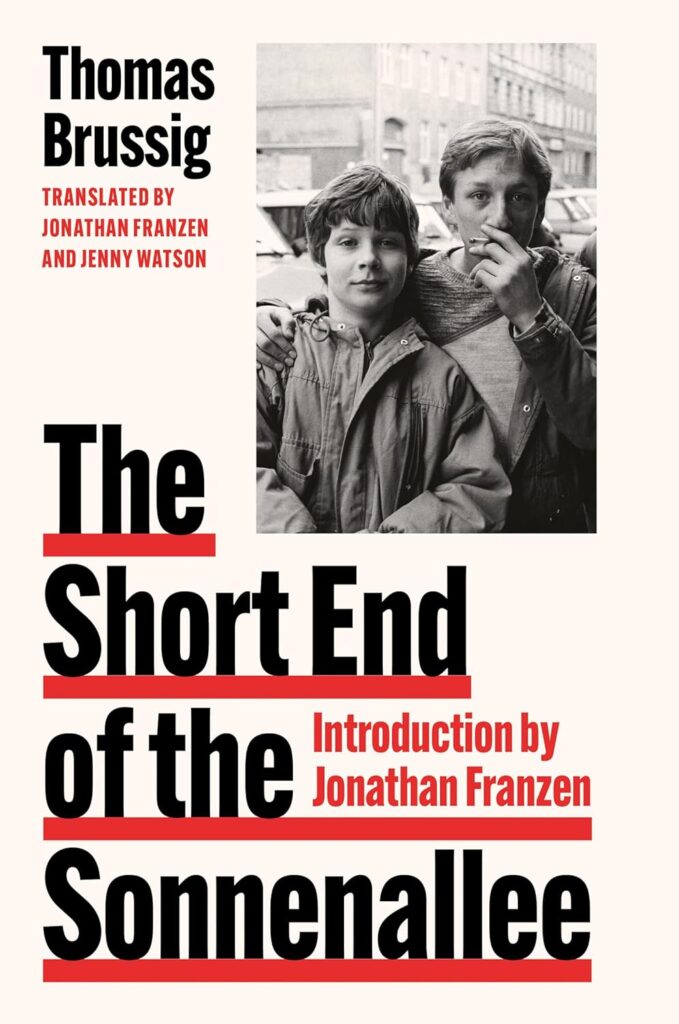
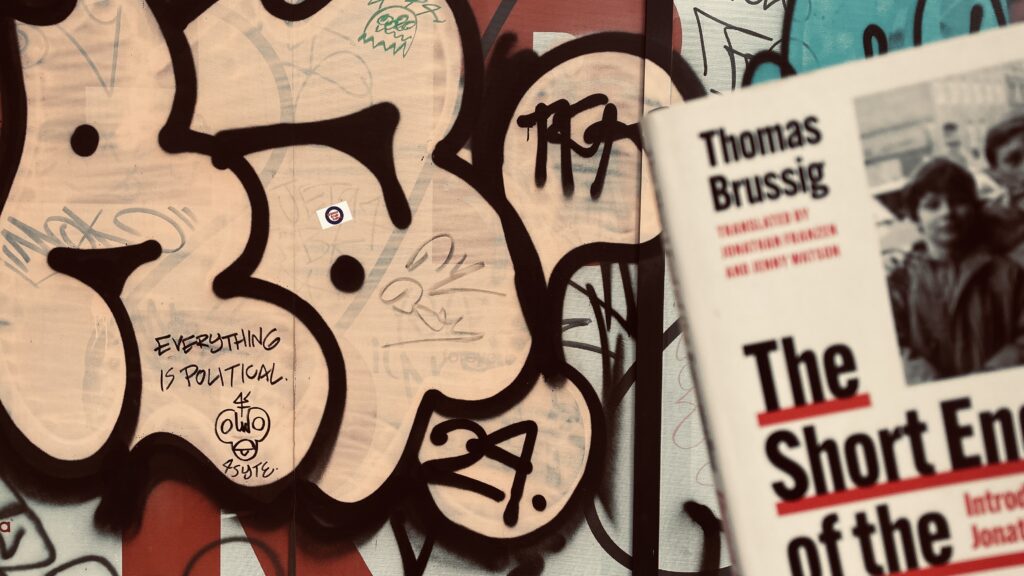
    Cover image for The Short End of the Sonnenallee by Thomas Brussig

    Think Derry Girls, but with a bunch of lads living in 80s East Berlin, quite literally in the shadow of the infamous wall. In less than 150 pages, it made me laugh out loud more times than I had ever expected, especially considering that the former East Germany isn’t exactly the conventional setting for a laugh. This juxtaposition is what gives it such power, lifting it from coming-of-age comedy to razor-sharp satire.

    It begins right from the title. ‘Sonnenallee’ is German for ‘Avenue of the Sun’ — or ‘Sunny Street’, in the novel’s own vibe — and the ‘short end’ refers to the part of that street cut off by the Berlin Wall, left behind in the East. In English, it also evokes ‘the short end of the stick’, implying an awareness amongst the residents that they’ve got the worse bargain. (I wonder if this is an intentional reference in the German, too.)

    This current runs right through the novel, alternating between the boys’ recognition of their luck in life (Churchill gave their bit of the street away to Stalin in exchange for a match for his cigar; so goes the local legend) to small acts of rebellion against their dictated fates (one boy believes that acquiring a banned Rolling Stones album will literally change his life). It creates a comedic tension that absolutely lights up this sunny street.

    Under its surface of silliness and teenage apathy, the book does something else which is equally remarkable. It tears apart the stereotypes of life in East Germany — even more entrenched after the success of The Lives of Others — as an Orwellian dystopia devoid of joy, where Stasi men in grey jackets lurked on every grey street, waiting to catch you making a joke so they could drag you into the back of a grey van. It may be based in truth, sure. But, like all stereotypes, it also swallows other truths. Like the fact that those living in a haze of oppression can still find love, still concoct crazy dreams. Or, that young people, no matter where they are, find their own ways to freedom. Usually via the lolz.

    Authoritarians, entrenched or aspiring, want us to think that they’re scary as hell, a danger to everything and everyone we hold dear. That fear is the source of their power. It’s important to take the threat seriously, to fight it in serious ways. But young people remind us — whether in 80s East Berlin or 2025 Britain — that mockery can be just as effective at cutting paper monsters down to size.


    Cover image for The Short End of the Sonnenallee

    FEATURED BOOK

    The Short End of the Sonnenallee
    by Thomas Brussig, translated by Jonathan Franzen and Jenny Watson


    Get the next one in your inbox

  • Waiting in the dark: how to find wonder in a powercut

    ‘Why were we messing around with trigonometry? We should’ve been learning about taxes!’

    My oldest friend often airs this complaint about our school days, usually down a couple of pints. Perhaps he’s right, though I doubt it would’ve helped. (I did learn trigonometry, after all, and the only tangents I can calculate are ones like this.) Plus, taxes are like death: something to accept, not understand — much less cheat. No: what they should’ve taught us is how to wait.

    It’s not that there weren’t enough opportunities to learn it. Childhood, as I recall it, was an exercise in waiting. Waiting for holidays and birthdays, festivals and friends, for the rain to stop, the bell to ring, the Sunday cartoons to start showing. Most of all, it felt like an interminable wait for childhood itself to end, for real life to begin. With all of that training, one would think we’d be experts at this game, masters of the art of patience.

    And yet.

    I could bet — if I had a penny not already owed to some billionaire — that even as you read this, you’re waiting for something. An email, a phone call, a report from a doctor, a letter from the government, a sign from God. And chances are that it’s a small fire burning at the back of your mind, driving you to fidget, to doomscroll, to stand in an alley sucking on a vape. (I’m not projecting; you’re projecting.)

    It doesn’t help that our culture seems to treat waiting as some kind of personal failure, a punishment for chumps. Podcasts dangle early access to episodes. Shopping sites nudge you to ‘get it today,’ Even my bank keeps offering me savings accounts with ‘instant access’, presumably designed for instants where I have a gun to my head.

    It feels futile to complain about this glorification of impatience, let alone fight it. That doesn’t mean we shouldn’t.

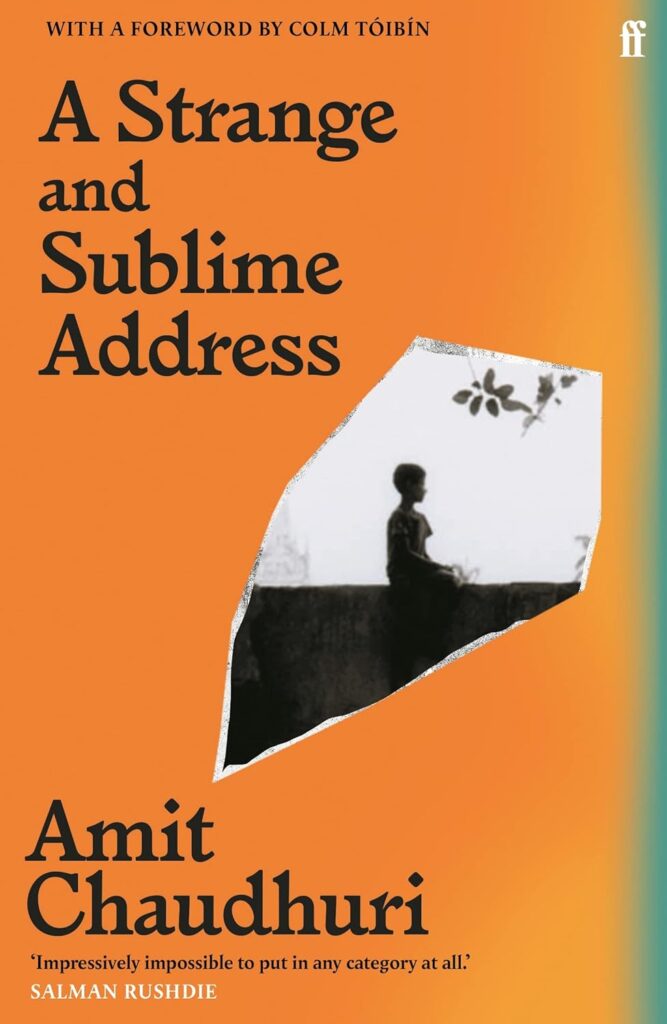
    Cover image for A Strange and Sublime Address by Amit Chaudhuri

    Set in 1980s Calcutta, it’s a mesmerising time-capsule of a world where, at first glance, nothing much seems to happen. A ten-year-old boy visits his uncle’s house in Calcutta, spends the summer holidays watching his relatives. There are long, lazy afternoons beseiged by heatwaves, liberated by thunderstorms. There are trips to the market in an unreliable old car. There’s a ceiling fan that swings side to side, ‘like a great bird trying to fly’.

    There’s one passage in particular that has lived in my head for years:

    Each day there would be a power cut, and each day there would be the unexpected, irrational thrill when the lights returned. […] With what appeared to be an instinct for timing, the rows of fluorescent lamps glittered to life simultaneously. The effect was the opposite of blowing out candles on a birthday cake: it was as if someone had blown on a set of unlit candles, and the magic exhalation had brought a flame to every wick at once.

    Growing up in India, I lived through my share of power cuts (and yours, too, I reckon). While I don’t remember them with much fondness, I certainly recognise the feeling Chaudhuri captures here — the ‘irrational thrill’ that shoots through you like a bolt of lightning when the world, dark for so long, lights up again.

    Re-reading the passage now, it occured to me that its real beauty lies in what it leaves unsaid. That first comma in the first sentence — the pause between the electricity leaving and returning — is a power cut in prose form, shrouding in darkness the true source of its ultimate wonder. It’s that long suspension — fanning yourself with a folded-up newspaper, watching the candlelit shadows shiver across the walls, trying and failing, over and over again, to distract yourself from the fear that the lights may never light up again — that makes the climax so magical. It’s the wait that makes it worthwhile.

    Such is the effect of Chaudhuri’s prose — the mastery with which he channels that most potent force of nostalgia — that, depsite my own harrowing memories of power cuts, I was left pining for one. Not because I miss the suffocating heat of the Indian summer. Because it feels like the only way to stop the relentless onslaught of cognitive overload. To pause.

    Perhaps it would do us some good to try it, every once in a while — without suffering a power cut. (And without condemning outselves to some horrifying digital detox retreat.)

    What if we tried to build it into our routines, I wonder. Deliberately missing that bus or train to take the next one, for instance. Or, like my father, arriving five hours early for a flight. What if we resisted the dopamine shots served by the algorithms and just sat around and waited?

    If you do try it, this book might turn out to be the perfect companion.


    FEATURED BOOK

    A Strange and Sublime Address
    by Amit Chaudhuri


    Get the next one in your inbox